
Overview
Welding, cutting, open torches and other hot work operations and equipment shall comply with all UCSF policies and Chapter 35 of the California Fire Code.
Hot Work– Hot Work includes, but is not limited to: brazing, torch cutting, grinding, soldering, and welding. The UCSF Hot Work Hazardous Conditions Permit (Appendix A) is required for any operation on UCSF property involving hot work.
Hot work permits, issued by an approved responsible person under a hot work program, shall be available for review by the fire code official at the time the work is conducted and for 48 hours after work is complete.
CONSTRUCTION PROJECTS AT UCSF
A Hot Work Permit Plan shall be included with a project’s Site Safety Plan when hot work is part of a project scope. These plans are reviewed and approved by the DCFM prior to construction. Hot Work Permit Plans shall be approved in Accela under Conditions as “Approved Site Safety Plan and Hot Work Permit Plan.” Requirements for Hot Work are established by CFC Chapter 35 and NFPA 51B.
Hot Work Plans shall be emailed directly to the project’s DCFM for review along with the Site Safety Plan and shall be approved prior to the pre-construction meeting.
The Hot Work Plan shall meet or exceed all elements as outlined in CFC Chapter 35: Welding and Other Hot Work, and may include elements of NFPA 51B: Standard for Fire Prevention During Welding, Cutting, and Other Hot Work.
Hot Work Permits are issued by the General Contractor to sub-contractors each time they perform hot work, following their approved Hot Work Plan. Hot Work Permit Plans shall include a Precautions Checklist to be used by Hot Work Operators.
The approved Hot Work Plan and Hot Work Permits shall be available for review by the DCFM at the time the work is conducted and for 48 hours after work is complete. It shall be the responsibility of the General Contractor to manage all hot work on the job site.
The foundation of the program is the policy that no person can perform a welding or cutting operation outside a designated area without an approved hot work permit.
ROUTINE MAINTENANCE & REPAIRS BY UCSF CAMPUS AND HEALTH FACILITIES
Hot work being conducted for routine building and equipment maintenance and repair is permitted through UCSF Health and Campus Facilities Services.
The hot work permit must be completed by the competent individual responsible for this work and reviewed and approved by a designated Permit Authorizing Individual (PAI) in Campus or Health Facilities.
Specific hot work conditions and requirements, including Fire Watch, are listed on this permit.
Permit Authorizing Individuals must take Hot Work Permits training (1 hour) on UC Learning Management System every three years or when there are code changes requiring updated training.
Hands-on fire extinguisher training shall be taken in-person by UCSF Fire Prevention or may be taken through Learning Management System “Fire and Life Safety” training (15 minutes). Required annually.
Records of approved Hot Work shall be available for review by the DCFM at the time the work is conducted and for 48 hours after work is complete. It shall be the responsibility of the Permit Authorizing Individuals and the General Contractor to manage all hot work on the job site.
UCSF Fire Prevention will ensure available training on UC Learning is current and up to date.
The foundation of the program is the policy that no person can perform a welding or cutting operation outside a designated area without an approved hot work permit.
Specific precautions must be taken during hot work operations due to the potential for uncontrolled ignition sources to cause a fire. The hot work permit provides a step-by-step checklist or safety precautions for the supervisor, operator, and fire watch to follow before, during and after work.
It is the employee’s responsibility to follow this policy and to be aware of the hazards associated with hot work. Consultation with UCSF Fire Prevention is always available upon request with sufficient notices (at least one week).
UCSF Health and Campus Facilities Hot Work Program has the following roles and responsibilities of key personnel including the permit authorizing individual, hot work operator, and fire watch.
Further Requirements and References from California Fire Code, Chapter 35 Welding and Other Hot Work
Designated or Fixed Hot Work Areas - A specific location designed and approved for hot work operations that is maintained fire-safe, such as a maintenance shop or a detached outside location, that is of noncombustible or fire- resistive construction, essentially free of combustible and flammable contents, and suitably segregated from adjacent areas. Designated or Fixed Hot Work Areas must demonstrate the area meets minimum required ventilation rates to maintain vapors, fumes and smoke below a hazardous level in accordance with CalOsha 1536. These locations shall be approved by UCSF Fire Prevention and reviewed at least annually.
Permit Authorizing Individual –
The Permit Authorizing Individual (PAI) will look for alternative to hot work. If hot work is needed, then PAI will:
- Inspect permit-required areas with Hot Work Operator utilizing the Precautions Checklist
- Issue, sign, and cancel permits
- Maintain instrumentation
- Understand the Site Safety Plan or Emergency Action Plan
All hot work operations should be under the control of a competent Permit Authorizing Individual (PAI). PAI to ensure:
- Hot work permit is issued
- Equipment is in good repair
- Employees are trained in safe operation of equipment
- Personnel follow hot work procedures, including use of Precautions Checklist
Hot Work Operator –
The Hot Work Operator completes the permit and submits it to the PAI for review and approval.
The Operator’s primary responsibility (among others) is to verify a clear escape route.
Hot Work Operator:
-
Inspects the permitted hot work area with PAI utilizing the Precautions Checklist
and verifies the conditions specified on the permit
-
Verifies the location of the nearest alarm pull station, fire extinguisher,
and accessible phone with contact to UCSF Police Department emergency number 415-476-6911
- Stops all hot work if any unsafe conditions develop, and notifies the PAI for reassessment of the situation
- Verify a clear escape route and know emergency procedures in the event of a fire
- Ensures proper placement of hazard identification signs where the area is accessible to persons other than the operator of the hot work equipment
-
Conspicuous signs shall be posted to warn others before they enter the hot work area.
Such signs shall display the following warning:
-

Fire Watch –
A fire watch during hot work is responsible for the surveillance of exposed areas to ensure safe conditions are maintained. The primary task of a fire watch is stopping operations if unsafe conditions develop.
A fire watch is required whenever combustibles are closer than 35 feet to point of operation, or more than 35 feet away but are easily ignitable.
The other two instances when a fire watch is required:
-
If wall and floor openings within 35 feet expose combustibles in adjacent areas,
including concealed spaces in walls and floors and
- If combustibles adjacent to the opposite side of metal partitions, walls, ceilings, or roofs may be ignited by conduction or radiation
Fire Watch must:
- Ensure safe conditions are maintained
-
Be present during hot work operations
and remain for a minimum of 30 minutes after completion –
PAI is authorized to extend the fire watch based on the hazards or work being performed.
- Be aware of worksite hazards and work procedures
- Stop operations if unsafe conditions develop
- Monitor exposed areas
- Have fire extinguisher with minimum 2-A:20-B:C rating - provided with ready access within 30 feet of the location where hot work is performed
- Be familiar with the facilities and the procedures for sounding the alarm
- Not be distracted from fire watch responsibilities
Protection of Hot Work Areas
Areas where hot work is performed must be properly prepared. Combustible and flammable materials within the work area must be protected against fire hazards, and the operation cannot pose a fire or health hazard to others in nearby areas.
- Sprinkler systems may not be shut off during hot work
- Use damp rags to shield individual sprinkler heads
- Perform all hot work in designated areas equipped with necessary controls and adequate ventilation
- Restrict all cutting and welding operations to authorized, properly trained individuals
-
Use fire-resistant curtains or blankets or tinted shields
to prevent fire, burns, and ultraviolet light exposure Never perform hot work in areas containing flammable or combustible materials or residues.
PPE must be used along with, but never instead of, engineering controls and safe work practices. Actions to minimize risks during hot work:
- Verify Lower Explosive Limit is lower than 10%
- Isolate flammable sources
- Purge and verify the absence of vapors or gases
- Use PPE along with engineering controls
- Tightly cover cracks and ducts
Hot Work Incidents at UCSF –
It should be noted that careless hot work at UCSF has contributed to several fires in the past. This policy is meant to help ensure the safety of the whole UCSF Community.
- Mission Bay PCMB (February 2018), Welding on the 4th floor ignited combustible material on the 3rd floor.
-
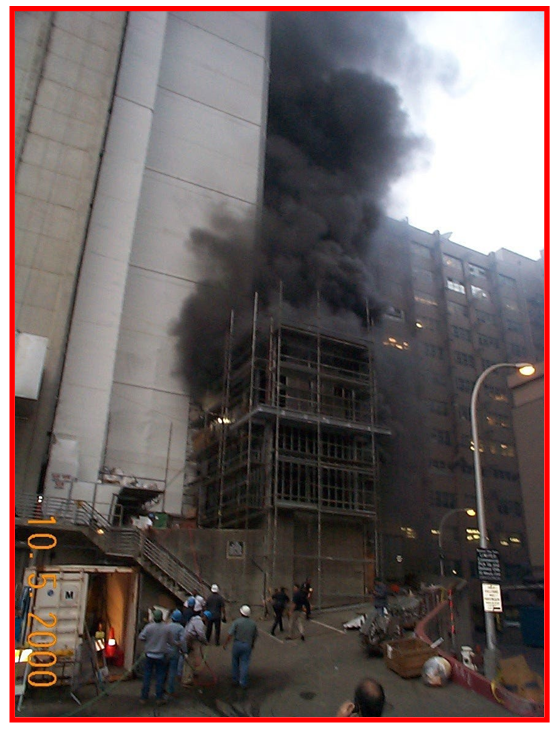
HSIR North Fan Room (October 2000, see picture below), Scaffolding fire due to hot work.
Cylinder and Container Storage, Handling and Use
The storage or use of a single cylinder of oxygen and a single cylinder of fuel gas located on a cart shall be allowed without requiring the cylinders to be separated in accordance with Section 5003.9.8 or 5003.10.3.6 when the cylinders are connected to regulators, ready for service, equipped with apparatus designed for cutting or welding and all of the following:
- Carts shall be kept away from the cutting or welding operation in accordance with Section 3505.5 or fire-resistant shields shall be provided.
- Cylinders shall be secured to the cart to resist movement.
- Carts shall be in accordance with Section 5003.10.3.
- Cylinder valves not having fixed hand wheels shall have keys, handles or nonadjustable wrenches on valve stems while the cylinders are in service.
- Cylinder valve outlet connections shall conform to the requirements of CGA V-1.
- Cylinder valves shall be closed when work is finished.
Cylinder valves shall be closed before moving the cart.